



Agentforce and AI Customer Service: What the Fin Acquisition Changes

Azimute
08/14/2026

Agentforce: what the Fin acquisition reveals about the future of AI-powered customer service
On June 15, 2026, Salesforce announced the acquisition of Fin, formerly known as Intercom, for approximately $3.6 billion. This isn't just another deal. It's the clearest signal yet that Salesforce is betting heavily on AI-driven customer service.
For business leaders, the deal value itself is secondary. What matters is understanding what actually changes: what customers will start to expect, what competitors will start to offer, and what your own Salesforce instance will be able to do in the coming months.
What Fin is, and why Salesforce paid so much for it
Fin started life as Intercom, one of the best-known customer support platforms on the market, founded 15 years ago. In 2023, as the first modern language models emerged, the company pivoted entirely toward AI, culminating in its rename to Fin, the name of its own AI agent.
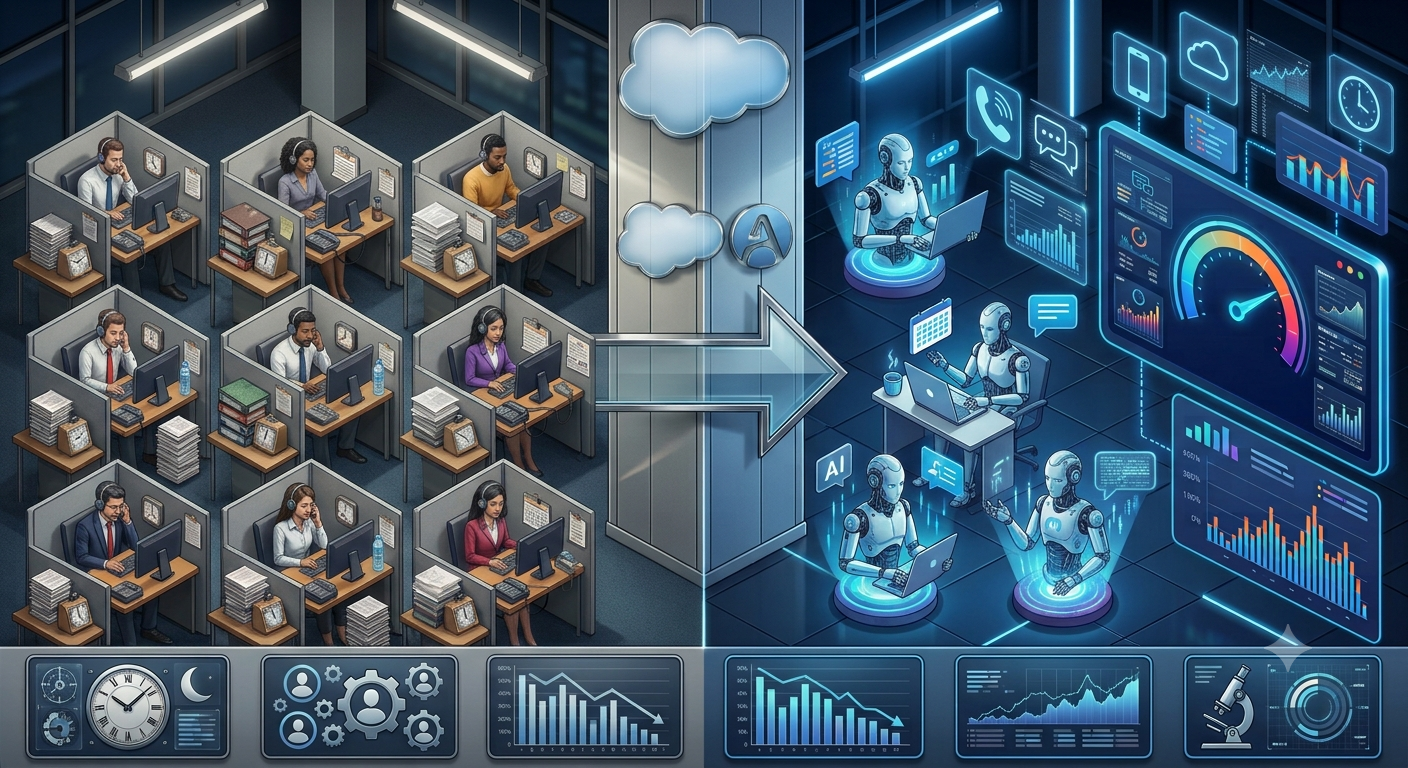
Fin's AI Agent resolves customer queries autonomously across multiple channels, live chat, email, WhatsApp, SMS, phone, and Slack, without needing a human to close the case. According to figures released by Salesforce, the agent resolves roughly 76% of support requests with no human intervention, and more than 30,000 businesses already use it. That track record, not just the underlying technology, is what led Salesforce to buy the company rather than try to build an equivalent in-house.
Agentforce: the centerpiece of Salesforce's AI strategy
Fin isn't joining Salesforce in isolation. It becomes part of Agentforce, the AI agent platform Salesforce launched to let any organization build its own autonomous assistants inside the Salesforce ecosystem. Agentforce has already reached $1.2 billion in annual recurring revenue, up 205% year over year, one of the fastest adoption curves in the platform's recent history.
The logic behind the deal is straightforward: Agentforce, as it existed, is a deep, highly customizable solution, but it takes time and technical resources to implement. Fin solves the opposite problem, it's ready to deploy within days. That combination is what Salesforce wants to offer: from a plug-and-play agent to a fully custom build, depending on each company's digital maturity.
If you've already looked at turning a , this is the natural next step, moving from static articles to AI-managed conversations.
This bet on autonomous agents is also forcing Salesforce to rethink how it charges for them, the traditional per-user model doesn't fit an agent that works around the clock. On that note, see our article on .
What this means for companies that aren't tech giants
It's tempting to assume this kind of technology only makes sense for large corporations. It doesn't. Salesforce has been explicit that the goal of the acquisition is precisely to make service agents accessible to companies of every size, including SMBs.
Lower operational costs: less dependency on support teams for repetitive cases
Immediate response: customers no longer wait for a human agent on simple questions
Consistency: every customer gets the same quality of answer, around the clock
Centralized data: every interaction feeds the same CRM, with no parallel systems
For senior leadership, this reinforces a point we've made before about turning Salesforce into the : more and more service decisions are also data decisions.
How to prepare your business for the age of AI agents in Salesforce
Before any company can benefit from an AI agent, whether from Fin, native Agentforce, or any other solution, one prerequisite doesn't change: the quality of the data inside the CRM.
An AI agent is only as good as the information it has access to. If your Salesforce instance has outdated knowledge articles, poorly documented processes, or inconsistent data, automation will amplify those problems rather than solve them.
Audit the current state of your data and knowledge base
Identify the most repetitive, highest-volume service processes
Define where automation adds value and where human contact still matters
Test on a small scale before rolling out across the whole operation
If you're unsure about the current state of your Salesforce instance, the article on the is a good place to start before moving to automation.
Azimute as a partner for this transition
At Azimute, we help companies lay the groundwork for this kind of shift, from cleaning and structuring data to implementing self-service flows and service automation in Salesforce. and find out whether your business is ready to take this step.
Azimute
08/14/2026



Frequently Asked Questions
Latest articles See all articles
m3ter e Agentforce Revenue Management: o Fim do Modelo "Por Utilizador"?
A Salesforce vai comprar a m3ter para levar a faturação por consumo ao Agentforce Revenue Management. Saiba o que isto significa para o orçamento e o licenciamento da sua empresa.
Azimute
08/28/2026
m3ter and Agentforce Revenue Management: The End of "Per Seat" Pricing?
Salesforce is acquiring m3ter to bring usage-based billing to Agentforce Revenue Management. Here's what it means for your company's budget and licensing.
Azimute
08/28/2026

Agentforce e Atendimento com IA: o que Muda com a Aquisição da Fin
A Salesforce comprou a Fin (ex-Intercom) por US$3,6 mil milhões para reforçar o Agentforce. Saiba o que este movimento significa para o atendimento ao cliente e como preparar a sua empresa.
Azimute
08/14/2026